
AI Forensic Reconstruction Report: Tate Homicide Blood Evidence
A forensic re-analysis of the Tate homicide using the original LAPD reports and S.I.D. blood-typing data and chatGPT.

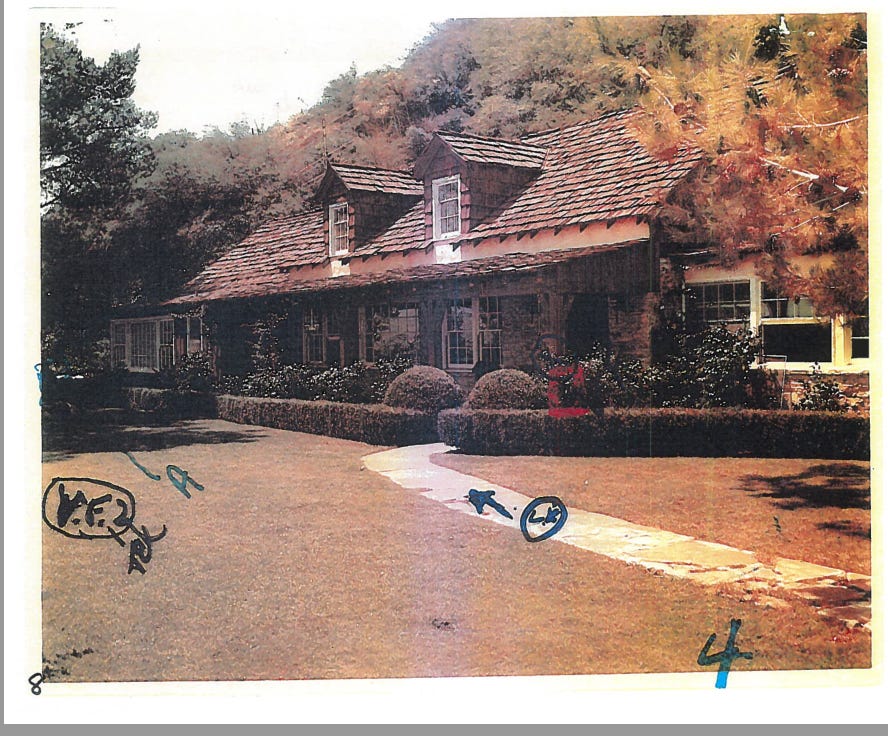
For years I’ve examined the Cielo Drive blood evidence on my YouTube channel — relying on my own eyes and the kind of forensic intuition you build after a lifetime in true-crime research. The contradictions were always there, hiding in plain sight, but without a structured forensic breakdown the full picture remained fragmented. This article expands on the analysis from last night’s stream: Tate Murder House Blood Evidence: What the Police Report Missed, and What ChatGPT Found.
This time, the analysis is different. I fed the original 1969 LAPD reports, the S.I.D. typed blood tables, and the crime‑scene stain catalogue into an AI workflow designed to behave exactly like a calm, methodical forensic analyst. It was instructed to rely only on physical evidence: typed blood, flow patterns, victim positions, liver temperatures, and scene diagrams — with testimony used only to highlight contradictions.
What follows is the condensed but complete reconstruction: clearer, sharper, and grounded entirely in the physical reality of what happened on the night of August 8th–9th, 1969. For years, I’ve examined the Cielo Drive blood evidence using only my own eyes and working knowledge of forensic principles. This time, the reconstruction was done by feeding the original 1969 LAPD reports, and S.I.D. typed blood tables into an AI workflow instructed to use physical evidence only — no testimony except for contradiction-checking.
Prompt Used
“Determine, from typed blood, stain distribution, liver temperatures, and scene diagrams, whether the physical evidence supports the claim that Tate and Sebring were attacked inside or outside. Reconstruct victim movement paths strictly from physical evidence. Identify contradictions between this and the official Atkins/Kasabian narrative.”
Primary Documents
LAPD Tate Homicide Investigation Progress Report
S.I.D. Blood Grouping Table
Below is the condensed but complete reconstruction.
1. Blood Types (The Forensic Foundation)
Typed blood is the backbone of this reconstruction — the one part of the record that cannot be spun, coached, or retrofitted into a courtroom narrative.
B-MN: Parent, Frykowski, Folger
O-MN: Sebring
O-M: Tate
These subtypes allow the scene to be sorted into distinct movement trails, separating victims with a precision that testimony never achieved. Once you follow the stains instead of the stories, the entire sequence changes. (Essential Framework)
B-MN: Parent, Frykowski, Folger
O-MN: Sebring
O-M: Tate
This allows all stains to be assigned to the correct victim.
2. Key Outdoor Findings
The front porch and threshold — not the living room — are where the night truly began. The evidence forms a picture of chaotic, violent confrontation before anyone ever crossed the doorway.
Sebring — The First to Fall
Sebring’s blood tells a story the prosecution never wanted to touch.
A heavy O‑MN pool (G‑5) sits high on the porch slab, flowing downward toward the steps.
The hedge above it shows snapped, crushed twigs, the unmistakable imprint of a body collapsing or being forced against it.
Inside, vertical O‑MN drips (G‑29) mark where Sebring was briefly upright or repositioned.
And finally, his blood appears on the inside gate button, evidence of the killers’ controlled exit.
Sebring was not shot inside and dropped instantly. He was gravely wounded outside first, moved while still bleeding, and used as a prop in a narrative that doesn’t match his own blood.**
Massive O-MN pool at G‑5 flowing down the porch.
Hedge above shows snapped twigs → body pressed into it.
Vertical O‑MN drips inside on G‑29 → moved after wounding.
O‑MN on gate button (G‑17) → killers exited via gate.
Conclusion: Sebring was gravely wounded outside first, not instantly killed in the living room.
Tate — Injured at the Doorway
Tate’s earliest blood (O‑M) sits right on the threshold.
These stains show she was injured as she approached or crossed the doorway.
She was bleeding before reaching the living room, contradicting every version that claims she stayed inside from the start.
Her final blood loss occurred inside — but her injury began outside or at the threshold, and the smearing pattern shows she was moved after the attack began.
O‑M stains at threshold (G‑4, G‑6, G‑35).
Pattern shows she was injured at/near the doorway before moving inside.
Largest O‑M pool is inside → final stage occurred there.
Frykowski — A Long, Staggering Flight
Frykowski’s B‑type blood marks a jagged path across the lawn:
two distinct collapse points,
partial recoveries,
attempts to flee,
and finally, the place where he fell for the last time.
This is not the clean, controlled “Tex chased him and killed him” scene retold in interviews. It is the record of a man fighting for his life in bursts of panic and adrenaline.**
Two collapse points → long struggle across lawn.
Movement inconsistent with a quick chase.
Folger — Her Whole Escape Path Preserved in B‑Type Drops
Folger’s movements are mapped almost frame‑by‑frame:
from the living room,
through the hallway,
into the master bedroom,
out the shutters,
across the patio,
and finally to the lawn.
Her blood reads like a testimony far more reliable than anyone’s spoken words. It reveals a determined escape, not the static, frozen scene described by the state.**
Full B‑type trail: living room → hallway → bedroom → shutters → patio → lawn.
Continuous escape path, not “ran out and died instantly.”
3. Inside the House
G‑29 (Both Trunks)
Typed O‑MN → Sebring only.
Vertical drips show Sebring was standing or repositioned inside.
Rope (G‑28)
Only O‑type blood → contact after Tate & Sebring were already bleeding.
4. Parent’s Killing — A Separate, Chaotic Encounter
Stephen Parent — often treated as an afterthought — deserves far more attention.
His liver temperature (92°F) places him nowhere near a clear “first kill.”
His watchband was sliced from his wrist by a defensive wound deep enough to sever tendons.
His car shows the unmistakable markings of panic: a hard reverse, a fence strike, and a desperate attempt to flee.
Parent didn’t die in a calm, neat sequence before the killers approached the house. His struggle was reactive, chaotic, and isolated, challenging the prosecution’s need for a clean opening act. (Condensed)
Liver temp 92°F (not markedly earlier than others).
B‑type blood only inside car → isolated event.
Vehicle damage shows panic escape attempt, not calm execution.
Conclusion: Parent was not a clean “first kill”; his death was separate and chaotic.
5. Physical Sequence — The Night as Told by the Evidence
It is a story of movement, chaos, and reactive violence, not the neat “Helter Skelter” theatre Bugliosi built for the courtroom.
Violence begins on the porch. Sebring was heavily wounded; Tate was also injured at the doorway.
Barefoot killer steps in O‑type blood → confirms outdoor struggle.
Frykowski + Folger flee on independent B‑type paths.
Tate + Sebring moved inside after the initial outdoor injury.
Parent killed separately during or after house violence.
Killers exit via the gate, not the fence.
6. Major Myths Debunked (Expanded)
These are the major claims that still circulate today, along with what the physical evidence actually shows.
Myth 1 — “The blood sat for weeks, so the tests are unreliable.”
This misconception comes from assuming LAPD collected wet samples, stored them in jars, and allowed them to degrade.
Reality:
SID typed dried stains fixed to surfaces, the same condition seen in cold cases decades later.
ABO + MN antigens remain stable for extremely long periods.
The fact that SID achieved full subtyping (O-MN, O-M, B-MN) proves the stains were chemically intact.
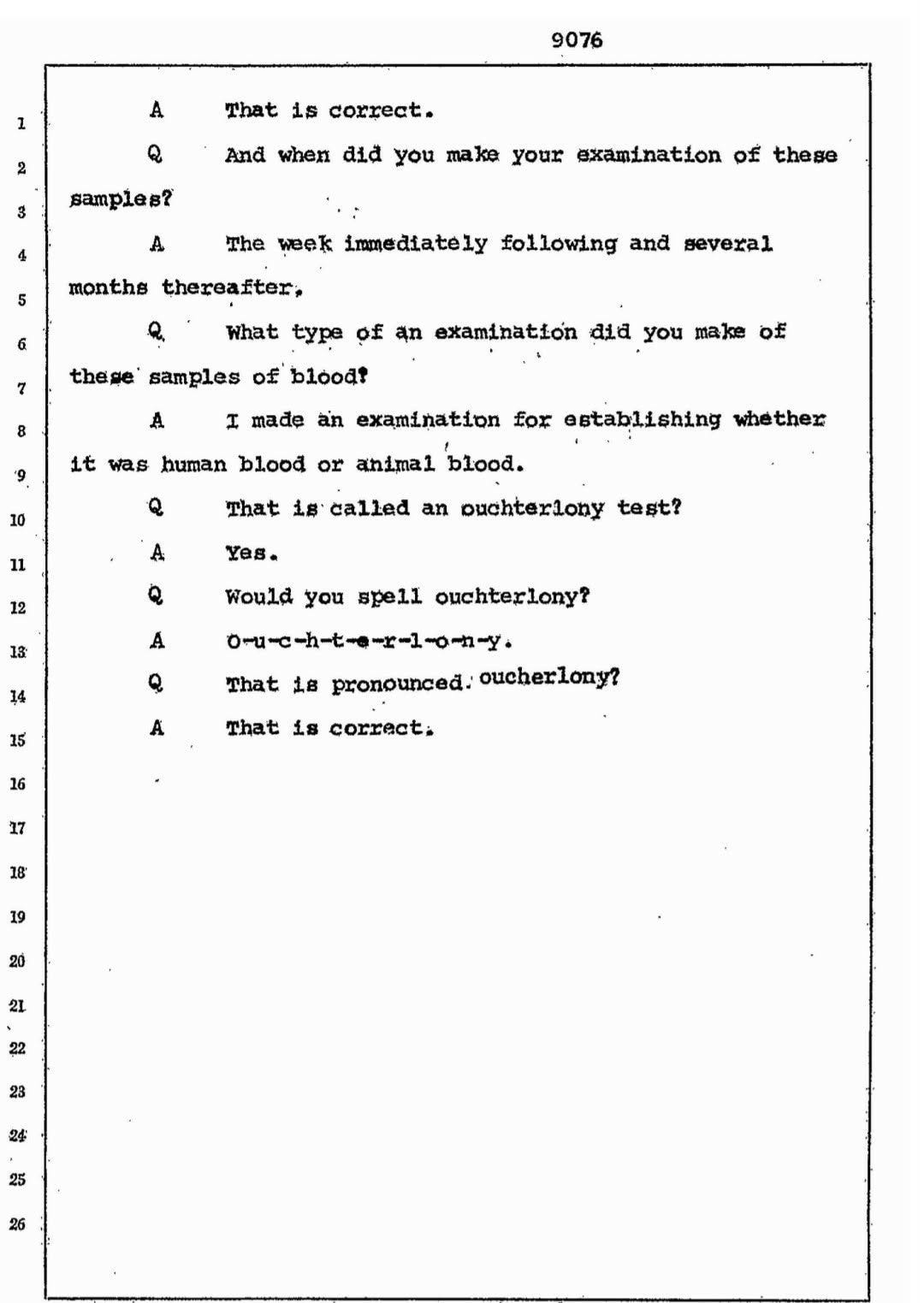
And an important clarification: People often confuse ABO/MN typing with Ouchterlony precipitin testing. Ouchterlony is a completely different immunodiffusion method used to determine species origin (e.g., human vs animal). Those tests do take days or weeks — but that’s normal and not a red flag. They have nothing to do with ABO or MN blood grouping.
Conclusion:
Nothing about the timeline or condition of the stains makes the blood typing unreliable. SID got clean, unambiguous results.
Myth 2 — “The porch blood was really B-type and LAPD mislabelled it.”
For this to be true, SID would have had to mislabel at least five stains (G-4, G-5, G-7, G-33, G-34) — all in the same area, all magically in the same direction, while correctly typing everything else on the property. All porch stains are O-type (Tate/Sebring), proving Frykowski and Folger were not bleeding there, Tate and Sebring were.
Myth 3 — “G-29 is Frykowski or Folger.”
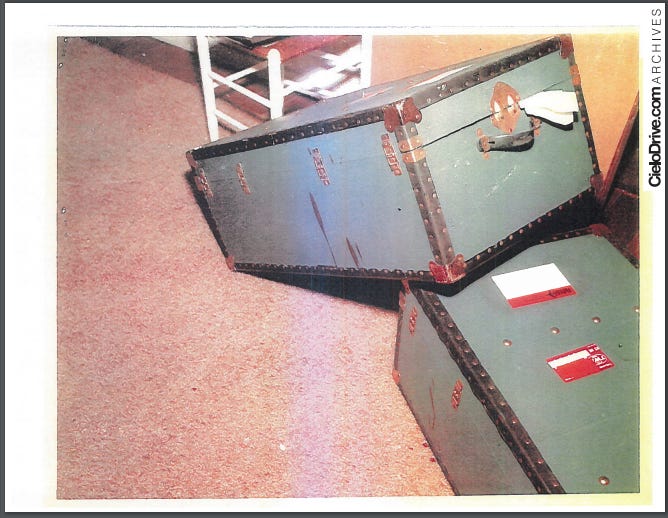
G-29 (trunk A and B) is O-MN — Sebring only. The vertical drip pattern proves Sebring was upright or being repositioned inside after being wounded outside. This directly contradicts the “instant indoor death” claim.
Myth 4 — “Sebring died instantly inside.”
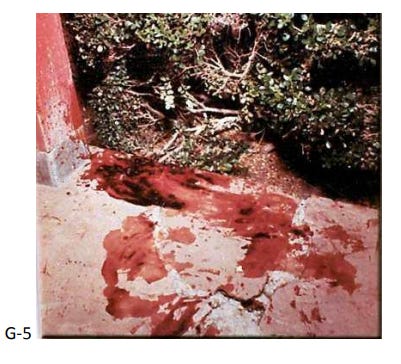
His blood is all over the porch (G-5), the walkway, inside on the trunks (G-29), and on the gate button. This is the pattern of a man gravely wounded outside and moved while still bleeding — not an instant death in the living room.
Myth 5 — “Tate never left the living room.”
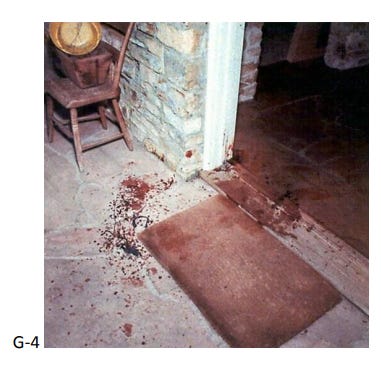
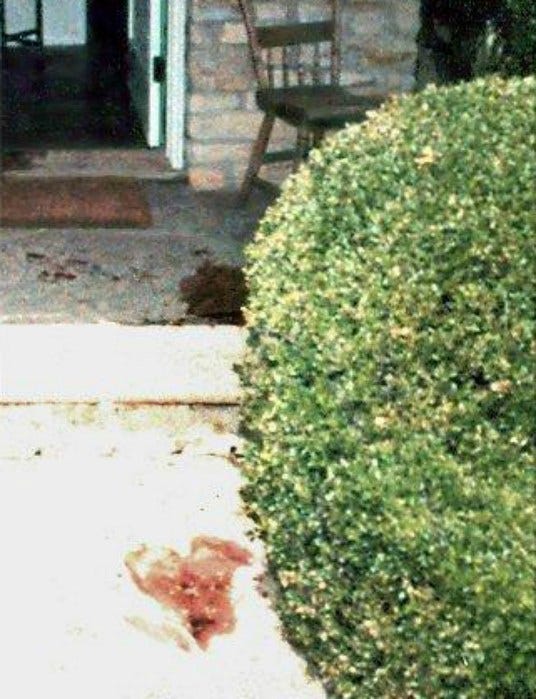
O‑M stains at the threshold show she was injured before entering. Smearing patterns confirm movement after injury. Her earliest bleeding occurred at or just outside the doorway, and an unnumbered O‑type stain on the walkway near the bush supports the same conclusion — that she was wounded before reaching the living room and moved while alive and bleeding.
Myth 6 — “Parent was the clean first kill.”
His liver temperature does not place him first. His watchband was severed by a defensive wound, and his car shows panic escape behaviour. His killing was isolated, reactive, and chaotic — not a calm prelude to the house attack.
7. Final Conclusions
The official Atkins/Kasabian/Bugliosi narrative required:
instant indoor killings,
clean linear order,
No outdoor injuries first, for Sharon and Jay
No movement after injury, for Sharon and Jay
The physical evidence contradicts every part of that story.
The forensic record shows a chaotic outdoor confrontation, multiple wounded victims moving across the property, and a controlled exit via the gate. This is not speculation — it’s what the typed stains, body positions, flow patterns, and temperature data actually show.
Sources
A concise list of the primary documents used in this reconstruction. You can insert your Dropbox links into each item.
Primary Evidence Files:
These three documents form the backbone of the reconstruction: typed blood, stain locations, wound patterns, body positions, and LAPD’s own contemporaneous descriptions.
If you want to see the publicly available crime-scene photographs (graphic), they’re archived here: https://www.crimeonline.com/2018/01/11/manson-family-cielo-drive-murders-graphic-crime-scene-photos-graphic/
Outro / My Thoughts
I had to condense this down as it was going to be too long to email. This version keeps all essential forensic findings without overwhelming you readers or email clients. The full reconstruction shows the prosecution relied on a narrative that does not match the physical evidence. My goal is not to replace one story with another — but to show what the evidence really says, and what it absolutely does not. I found it interesting that the AI kept saying it looked like Tate and Sebring’s Assault began entirely outside, suggesting maybe they tried to flee the house before they were injured, only to be stopped at the porch.
If you found this useful, please consider subscribing on Substack for deeper dives into the case and future reconstructions.
Great work! I wonder why they tried to create a different narrative. Time and technology catch up eventually.
The implication of your analysis is that Susan Atkins fabricated the story that the victims were first attacked inside the house. Of course, your conclusions are correct, that the bloodstains of the victims show that they were outside the house and then ended up inside the house, where the bodies were found.
I would like to offer an alternative hypothesis that would restore credibility to the Atkins account. As she said, Sharon and Jay were first attacked inside the house. Susan and company leave the premises, assuming that the victims were all dead. But they weren't all dead. Somehow Sharon and Jay survived the attack, either by feigning death or by losing conscienceness and waking up. Bleeding they go outside the house, seeking help. Loss of blood prevented them from going beyond the porch. That same night more intruders found Sharon and Jay still alive on the porch, dragged them back inside and delivered the final death blows.
According to Charles Manson, he and a partner went to the house before the police arrived to see "what his children had done." I believe they were the ones who really killed Sharon and Jay, not Tex and his team.